How to read a chord symbol
September 28, 2026 · Updated September 30, 2026
A chord symbol names a root and then says what to build on it. C means a C major triad. Cm means minor, C7 adds a flat seventh, Cmaj7 adds a natural seventh, and C/E means the same C chord with an E in the bass.
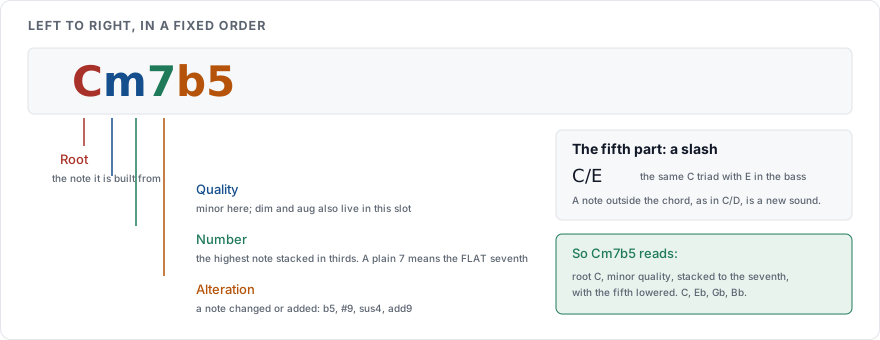
The parts, in the order they appear
Reading left to right, a symbol can carry five things, and most symbols use two or three of them.
| Position | What it says | Examples |
|---|---|---|
| Root | The note the chord is built from | C, F sharp, B flat |
| Quality | Major, minor, diminished or augmented | m, dim, aug |
| Number | The highest note stacked in thirds | 7, 9, 11, 13 |
| Alterations and additions | Notes changed or added | sharp 5, flat 9, sus4, add9 |
| Slash | A bass note that is not the root | /E, /G |
So Cm7flat5 reads: root C, minor quality, stacked to the seventh, with the fifth lowered.
Building the chord from the scale
Every symbol is shorthand for a set of degrees of the root's major scale, covered in How to build a major scale. C major gives C D E F G A B, numbered 1 to 7.
| Symbol | Degrees | Notes in C |
|---|---|---|
| C | 1 3 5 | C E G |
| Cm | 1 flat3 5 | C E flat G |
| Cdim | 1 flat3 flat5 | C E flat G flat |
| Caug | 1 3 sharp5 | C E G sharp |
| C7 | 1 3 5 flat7 | C E G B flat |
| Cmaj7 | 1 3 5 7 | C E G B |
| Cm7 | 1 flat3 5 flat7 | C E flat G B flat |
| Cm7flat5 | 1 flat3 flat5 flat7 | C E flat G flat B flat |
| Cdim7 | 1 flat3 flat5 doubleflat7 | C E flat G flat B doubleflat |
| Csus4 | 1 4 5 | C F G |
| Csus2 | 1 2 5 | C D G |
| Cadd9 | 1 3 5 9 | C E G D |
| C6 | 1 3 5 6 | C E G A |
| C9 | 1 3 5 flat7 9 | C E G B flat D |
Two of those rows carry most of the confusion.
The seventh that is not written
C7 has a flat seventh even though nothing in the symbol says flat. A bare number after the root means the dominant form, which takes the lowered seventh. To ask for the natural seventh you write maj7, and only then.
That asymmetry is historical: the dominant seventh chord was the common one, so it got the short name. Everything written with a plain 7, 9, 11 or 13 carries the flat seventh underneath.
Numbers above seven
A 9, 11 or 13 counts on past the octave, so a 9 is the second degree an octave up, an 11 is the fourth, and a 13 is the sixth. The number names the highest note of a stack that in principle includes everything below it, so C13 in full is C E G B flat D F A, which is all seven notes.
In practice a player drops what does not fit under the hand, and the notes that survive are the root, the third, the seventh and the number in the symbol. The fifth goes first and the eleventh usually goes next, because a natural eleventh clashes with the major third.
An add9 is a different instruction: it adds the ninth without the seventh. C9 has a B flat in it and Cadd9 does not.
Slash chords
A symbol after a slash is a bass note. C/E is a C major triad with E underneath, which is the same three notes rearranged, and it exists to give the bass line a step it would otherwise have to leap.
Where the slash note is outside the chord, as in C/D, the result is a new sound and not an inversion. Read it literally: play the C triad, put a D below it.
The symbols that vary by publisher
Notation is not standardised, so the same chord appears several ways.
| Chord | Written as |
|---|---|
| Minor | Cm, Cmin, C-, Cmi |
| Major seventh | Cmaj7, CM7, CΔ7, CΔ |
| Half diminished | Cm7flat5, Cø7 |
| Diminished seventh | Cdim7, Co7 |
| Augmented | Caug, C+, Csharp5 |
A minus sign means minor and a plus sign means augmented, which is worth knowing before a lead sheet in someone else's hand surprises you.
Sources
Open Music Theory, on chord construction, inversions and lead sheet notation
The Oxford Companion to Music, on the history of figured bass and chord symbols