How to read a three card spread
September 30, 2026
Decide what the three positions mean before you draw anything. The positions carry as much of the reading as the cards do, and choosing them afterwards lets you fit the meaning to whatever turned up.
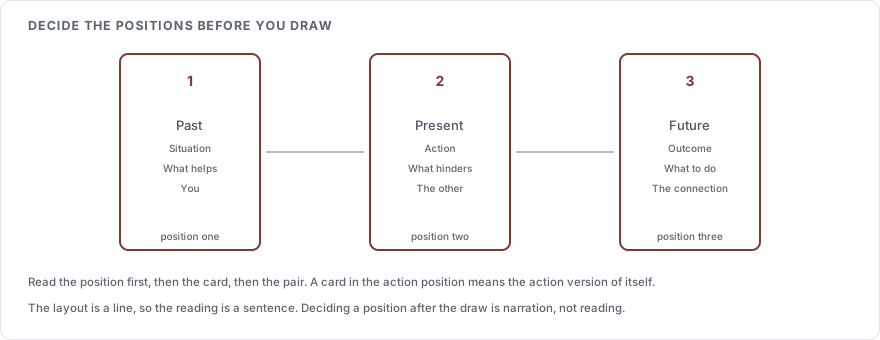
Fix the positions first
Past, present and future is the best known set, and it is one convention among many. Others in common use:
| Positions | Suits a question about |
|---|---|
| Past, present, future | How a situation arrived and where it is heading |
| Situation, action, outcome | A decision to be made |
| What helps, what hinders, what to do | Something already under way |
| You, the other person, the connection | A relationship |
| Mind, body, spirit | A general reading with no specific question |
Write the chosen positions down, or lay the cards on a cloth with the positions marked. A reader who decides that the third card "turned out to be about the past after all" has stopped reading a spread and started narrating.
The order of reading
Read the position first, then the card, then the pair together. So in a situation, action, outcome layout, the second card answers one question only: what to do. A card that would mean something else elsewhere in the spread means the action version of itself there.
After all three are read individually, read across them. Three things to look at:
The ratio of major to minor arcana frames the scale of the answer, under the convention described in How to tell the major arcana from the minor. Three majors is read as a large movement, three minors as ordinary business.
Repeated suits concentrate the reading, and what each suit carries is covered in How to read the four suits of the minor arcana. Two cups and a court card is treated differently from one card of each suit.
The direction of travel from first to third is where a three card spread earns its shape. The layout is a line, so the reading is a sentence.
A worked example
Question: whether to take a job offer. Positions chosen in advance as situation, action, outcome.
Say the draw is the Eight of Pentacles, the Two of Swords and the Six of Wands.
The first card sits in the situation position and shows a figure at work on a repeated task, which reads as the current job and steady craft in it. The second sits in the action position and shows a blindfolded figure holding two blades, which reads as a decision being avoided for want of information. The third sits in the outcome position and shows a rider being acclaimed.
Read as a line: the situation is competent and repetitive, the action required is to remove the blindfold and get the missing information, and the outcome position is favourable. The reading points at the middle card, because it is the only one describing something the querent does.
Reversals
Some readers turn part of the deck so that cards can land upside down and read that as a weakened, blocked or inverted meaning. Others read every card upright and take the nuance from the neighbours instead.
Decide which before shuffling, because a deck shuffled without reversals in mind will produce them at random and tempt a reading either way.
What the method is
Everything here describes the conventions of a practice. The positions are chosen by the reader, the meanings come from a tradition assembled from the 1780s onwards, and the cards come off the top of a shuffled deck.
What a three card spread reliably does is force a question into three parts and put a specific image against each one. Readers who find it useful tend to name that structure as the part that does the work, with the cards as the prompt.
Sources
Tarot, Wikipedia, on the history of divinatory use and on the decks in circulation
The booklet published with your own deck, since card meanings differ between decks and its designer's intentions are the ones the pictures carry
How to tell the major arcana from the minor, for the structure the ratio is counted from