How to find the aspects in a birth chart
September 29, 2026 · Updated September 30, 2026
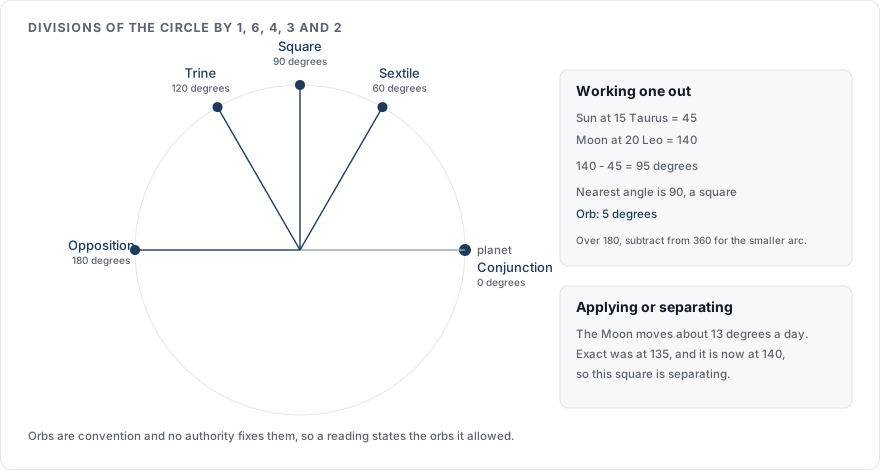
An aspect is the angle between two points in a chart, measured in degrees of ecliptic longitude. Subtract one longitude from the other, take the smaller of the two arcs, and compare the result against the recognised angles.
Converting a position to a longitude
Chart positions are written by sign, as in 15 degrees Taurus. To do arithmetic on them, convert to absolute longitude by counting whole signs from 0 degrees Aries.
| Sign | Starts at | Sign | Starts at |
|---|---|---|---|
| Aries | 0 | Libra | 180 |
| Taurus | 30 | Scorpio | 210 |
| Gemini | 60 | Sagittarius | 240 |
| Cancer | 90 | Capricorn | 270 |
| Leo | 120 | Aquarius | 300 |
| Virgo | 150 | Pisces | 330 |
So 15 degrees Taurus is 30 + 15 = 45. And 20 degrees Leo is 120 + 20 = 140.
Working one out
Sun at 15 Taurus, Moon at 20 Leo.
Longitudes: 45 and 140.
Difference: 140 - 45 = 95 degrees.
That is under 180, so it is already the smaller arc. Where a difference exceeds 180, subtract it from 360.
The nearest recognised angle is 90, a square, and the measurement misses it by 5 degrees.
The Sun and Moon are in square aspect with an orb of 5 degrees.
The angles
The five that Ptolemy set out in the second century are still called the major or Ptolemaic aspects.
| Aspect | Angle | Glyph | Typical orb allowed |
|---|---|---|---|
| Conjunction | 0 | ☌ | 8 to 10 degrees |
| Sextile | 60 | ⚹ | 4 to 6 degrees |
| Square | 90 | □ | 6 to 8 degrees |
| Trine | 120 | △ | 6 to 8 degrees |
| Opposition | 180 | ☍ | 8 to 10 degrees |
Later practice added minor aspects with tighter orbs: the semisextile at 30, the semisquare at 45, the sesquiquadrate at 135 and the quincunx at 150.
The major angles are the divisions of the circle by 1, 2, 3, 4 and 6. That arithmetic is the reason they were chosen, and it is the same logic that generates consonant intervals in music from simple ratios.
What each one is conventionally read as
Having found an aspect, this is what the Western tradition takes it to mean. These readings are convention, and the measurement stops at the angle. They also vary between schools.
| Aspect | The usual reading |
|---|---|
| Conjunction | The two planets act as one, each colouring the other, for better or worse depending on the pair |
| Sextile | An opening that has to be taken up before it does anything |
| Square | Friction between two drives, and the aspect most often described as the one that forces something to happen |
| Trine | The two work together without effort, which practitioners also read as a talent easy enough to neglect |
| Opposition | A pull between two poles, often described as showing up through other people before it is recognised inwardly |
Squares and oppositions were historically called hard or malefic aspects and trines and sextiles soft or benefic. Most modern practice has dropped the moral framing while keeping the distinction between aspects that produce tension and aspects that produce ease.
Orbs, and why they are argued about
An orb is the allowance either side of the exact angle within which an aspect still counts. No authority fixes them, and the figures above are what most practitioners use.
Two adjustments are widespread. Aspects involving the Sun or Moon are given wider orbs than aspects between two outer planets. Minor aspects are given orbs of two or three degrees at most, because a wide orb on a minor aspect makes almost every pair of planets aspect every other one, which empties the technique of information.
State the orbs used alongside a reading. A chart described as having a Mars square Saturn at 9 degrees is making a claim that half of practitioners would not accept as an aspect at all.
Applying and separating
An aspect that has not yet reached its exact angle is applying. One that has passed it is separating. The distinction depends on which body is moving faster.
In the worked example, the Moon moves about 13 degrees a day and the Sun about 1. The square was exact when the Moon was at 135 degrees, and the Moon is now at 140, so it has passed. The aspect is separating.
Most practitioners weight an applying aspect more heavily than a separating one.
What the measurement does and does not settle
The longitudes come from an ephemeris and are astronomy. The subtraction is arithmetic. Everything after that, including which angles count, how wide an orb to allow and what an aspect is taken to mean, is convention that varies between schools and has changed over time.
A reading is clearer when those two halves stay visibly separate: here is the measured angle, and here is the tradition's reading of it.
Sources
Ptolemy, Tetrabiblos, Book I, where the five major aspects are set out as divisions of the circle
JPL Horizons, for planetary longitudes to whatever precision you need
How to read a birth chart, for where the aspect lines are drawn on the wheel