How to build a major scale
September 28, 2026 · Updated September 30, 2026
A major scale is seven notes in one fixed pattern of steps: tone, tone, semitone, tone, tone, tone, semitone. Start on any note and follow that pattern, and the notes you land on are that note's major scale.
The pattern on a keyboard
A semitone is the distance from one key to the one immediately beside it, black or white. A tone is two semitones.
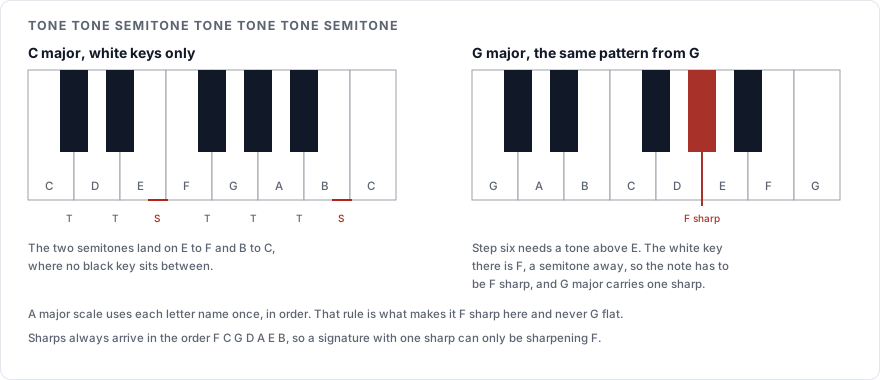
Start on C and follow the pattern using only white keys and it comes out right. The two places where white keys sit side by side with no black key between them, E to F and B to C, are the two semitones the pattern asks for. C major is the only major scale with no sharps or flats, and that is the reason.
Start anywhere else and the black keys have to make up the difference.
Building G major
Begin on G and apply the steps.
| Step | From | To | Interval needed |
|---|---|---|---|
| 1 | G | A | tone |
| 2 | A | B | tone |
| 3 | B | C | semitone |
| 4 | C | D | tone |
| 5 | D | E | tone |
| 6 | E | F sharp | tone |
| 7 | F sharp | G | semitone |
Step 6 is where it bites. E to F is a semitone on the keyboard and the pattern wants a tone, so the note has to be F sharp. G major carries one sharp, on F.
Building F major
The same walk from F gives F, G, A, B flat, C, D, E, F. The third step, A to B, is a tone on the keyboard where the pattern wants a semitone, so the note has to be B flat. F major carries one flat, on B.
Why it is B flat and never A sharp
A major scale uses each letter name once, in order. F major runs F, G, A, B, C, D, E: seven letters, each appearing once. Writing that fourth note as A sharp would give two notes called A and none called B, which makes the scale unreadable on a stave, where every line and space is a letter.
The same rule decides every spelling. G major takes F sharp because F is the letter still unused. A flat major takes D flat because D is the letter waiting for a note.
The order the sharps and flats arrive
Sharps always appear in the same order, and each new key adds the next one:
F C G D A E B
Flats appear in the reverse of that order:
B E A D G C F
Which gives the key signatures:
| Sharps | Major key | Flats | Major key |
|---|---|---|---|
| 0 | C | 0 | C |
| 1 | G | 1 | F |
| 2 | D | 2 | B flat |
| 3 | A | 3 | E flat |
| 4 | E | 4 | A flat |
| 5 | B | 5 | D flat |
| 6 | F sharp | 6 | G flat |
| 7 | C sharp | 7 | C flat |
Each new signature on the sharp side starts a fifth above the last one: C, G, D, A. Each new one on the flat side starts a fifth below: C, F, B flat, E flat. That relationship is what the circle of fifths draws, and How to find the key of a piece puts it to work.
What the scale is for
Numbering the notes from 1 to 7 gives you a way to talk about music in every key at once. The chord built on degree 5 pulls back to the chord on degree 1 whether you are in C or in F sharp. A chord symbol is shorthand for a stack of these degrees, which is the subject of How to read a chord symbol.
The minor scale you meet next is the same seven notes started from degree 6. A minor and C major share every note, which is why they share a signature.
Sources
Open Music Theory, a free textbook covering scales, key signatures and spelling rules
The Oxford Companion to Music, on the history of the major mode