How to read a birth chart
September 29, 2026 · Updated September 30, 2026
A birth chart is a diagram of where the planets stood, seen from one place at one moment. Reading one means answering the same three questions about every planet. Which sign is it in? Which house does it fall in? What angles does it make to the others?
What you need before you start
Three pieces of information, and the third is the one people underestimate.
The date and the place set the planetary positions, which come from an ephemeris, a table of where each body sits on a given day. Those positions are astronomy, and any two chart programs will agree on them.
The time of birth sets the houses. The whole wheel turns once every 24 hours, so the eastern horizon moves through a degree every four minutes. An hour of uncertainty moves the entire house structure by half a sign, which changes which house every planet lands in. How to find your rising sign covers what to do when the time is unknown.
How the wheel is drawn
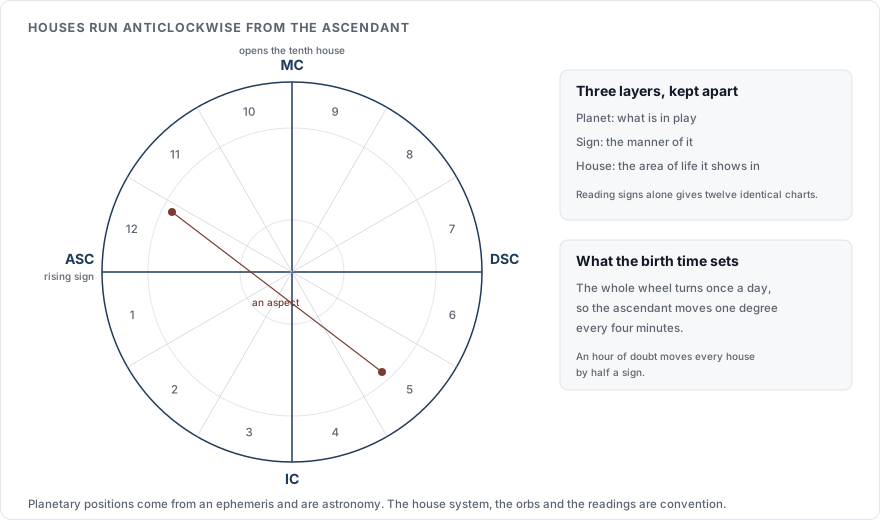
The chart is a circle divided into twelve houses, numbered anticlockwise starting from the left-hand edge. That left-hand point is the ascendant, the degree of the zodiac rising on the eastern horizon at the moment of birth.
Four points on the wheel carry their own names. The ascendant sits at the nine o'clock position and opens the first house. The descendant faces it at three o'clock. The midheaven, the highest point of the ecliptic at that moment, sits near the top and opens the tenth house, with the imum coeli opposite it at the bottom.
Signs are drawn around the rim as twelve equal thirty degree slices. Planets are marked at their degree, and lines drawn across the middle show the aspects between them.
The three layers
Western astrological practice separates what a chart says into three layers, and keeping them apart is most of what reading well involves.
| Layer | Question it answers | Example |
|---|---|---|
| Planet | What part of life is in play | Mercury, conventionally read as thinking and communication |
| Sign | The manner or style of it | Mercury in Gemini |
| House | The area of life it shows up in | Mercury in Gemini in the seventh house |
A planet is read through its sign and located by its house. Practitioners who begin with sign meanings alone tend to produce twelve interchangeable readings, which is the usual complaint about newspaper columns, where only the Sun's sign is used.
Where to start reading
The conventional order of importance in modern Western practice puts three things first: the Sun, the Moon and the ascendant. The Sun's sign is the one a person already knows. The Moon and the ascendant are what a chart adds to that.
After those, look at the ruling planet of the ascendant, then at any planet making tight aspects to the Sun, Moon or ascendant, then at whichever house holds several planets at once.
The glyphs
| Planet | Glyph | Sign | Glyph |
|---|---|---|---|
| Sun | ☉ | Aries | ♈ |
| Moon | ☽ | Taurus | ♉ |
| Mercury | ☿ | Gemini | ♊ |
| Venus | ♀ | Cancer | ♋ |
| Mars | ♂ | Leo | ♌ |
| Jupiter | ♃ | Virgo | ♍ |
| Saturn | ♄ | Libra | ♎ |
| Uranus | ♅ | Scorpio | ♏ |
| Neptune | ♆ | Sagittarius | ♐ |
| Pluto | ♇ | Capricorn | ♑ |
| Aquarius | ♒ | ||
| Pisces | ♓ |
The Sun and Moon are called the luminaries and are counted among the planets by convention, which is a habit inherited from a geocentric model of the sky.
What varies between practitioners
A chart's planetary positions are fixed by astronomy. Almost everything above them is convention, and the conventions differ.
House systems divide the wheel by different methods, so the same birth data produces different house cusps in Placidus, Koch, Equal or Whole Sign. Some traditions use the tropical zodiac, measured from the spring equinox, and others use the sidereal zodiac, measured against the fixed stars, which currently differ by about 24 degrees.
Practitioners also disagree on whether to include the outer planets, asteroids or calculated points. A reading states which system it uses, because two readings of the same chart under different systems are not comparable.
Sources
Ptolemy, Tetrabiblos, second century, the foundational text for the Western technical vocabulary of signs, houses and aspects
How to measure an aspect, for the angles drawn across the middle of the wheel
Planetary positions in any chart come from an astronomical ephemeris, such as the JPL Horizons system, which is where the measurable part of a chart ends