How to tell a tropical chart from a sidereal one
September 29, 2026 · Updated September 30, 2026
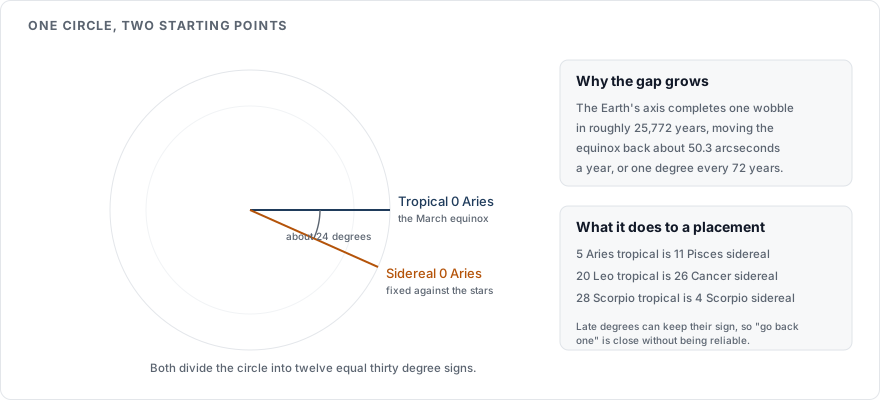
Two zodiacs share the same twelve names and begin in different places. The tropical zodiac starts at the spring equinox. The sidereal zodiac is tied to the fixed stars. The gap between them is currently about 24 degrees, which is most of a sign.
What each one is measured from
The tropical zodiac defines 0 degrees Aries as the point where the Sun crosses the celestial equator going north, the March equinox. Every sign is a thirty degree slice counted from there, and the whole frame is anchored to the Earth's seasons.
The sidereal zodiac anchors 0 degrees Aries to a position among the constellations instead. Several definitions exist, and they differ from each other by a degree or so.
Both divide the same circle into twelve equal parts. They disagree about where to start counting.
Why the gap exists and grows
The Earth's axis wobbles like a slowing top, completing one turn in roughly 25,772 years. That is the precession of the equinoxes, and it moves the equinox point backwards against the stars at about 50.3 arcseconds a year, which is one degree roughly every 72 years.
The two zodiacs coincided at some point in the first millennium, and they have been separating ever since. The offset has a name, the ayanamsa, and the commonly used Lahiri value sits near 24 degrees in the 2020s.
What that does to a chart
Twenty-four degrees is four fifths of a sign, so most placements move back one sign when a chart is recast sidereally.
| Tropical position | Approximate sidereal position |
|---|---|
| 5 degrees Aries | 11 degrees Pisces |
| 20 degrees Leo | 26 degrees Cancer |
| 28 degrees Scorpio | 4 degrees Scorpio |
The last row shows the exception: a placement late in a sign can stay in the same sign, which is why a blanket rule of "go back one" is close but not reliable.
Someone born in the first days of a tropical sign is usually in the previous sign sidereally, which accounts for much of the confusion people meet when a Vedic astrologer gives them a different Sun sign from the one they grew up with.
Who uses which
Western astrology has used the tropical zodiac since Ptolemy, whose second century Tetrabiblos sets out the framework that Western practice still follows.
Indian astrology, called Jyotisha or Vedic astrology, uses the sidereal zodiac, along with a different house system, a different set of aspect rules and its own timing techniques. The zodiac is one difference among several, so a sidereal chart is rarely just a Western chart shifted.
A smaller sidereal Western tradition exists, which uses the sidereal zodiac with otherwise Western technique.
How to tell which one you are looking at
Check the software setting first, since every chart program names it, usually as a zodiac or ayanamsa option.
Failing that, check the Sun against the birth date. A birth on 10 April with the Sun shown in Aries is a tropical chart. The same birth with the Sun in Pisces is sidereal.
The ascendant will also differ by the same offset, which means every house placement moves with it.
Which one is correct
The question does not have a measurement that settles it, because both are conventions for dividing a circle and neither claims the constellations are equal in size or that the stars sit where the signs do.
What matters in practice is consistency. A chart read with sidereal positions and Western sign meanings mixes two systems whose rules were developed separately, and produces something neither tradition would recognise. State which zodiac a chart uses, and stay in one.
Sources
IERS, for the measured precession of the equinoxes and current Earth orientation values
Ptolemy, Tetrabiblos, the origin of the tropical framework in Western practice
How to read a birth chart, for the other conventions a chart has to declare