How to sear a steak
September 30, 2026
A crust forms when the surface is dry and the pan is hot. Everything else about searing follows from those two conditions, including why the steak gets left alone once it is down and why a wet steak greys instead of browning.
Why dryness decides it
Browning is the Maillard reaction, the set of reactions between amino acids and sugars that Louis-Camille Maillard described in 1912. It runs at useful speed somewhere above 140 C.
Water boiling off the surface holds that surface at 100 C for as long as any of it remains. A steak straight from its packaging carries enough moisture to keep the surface pinned below browning temperature for minutes, by which time the inside is cooked and the outside is grey.
So: unwrap the steak, blot both faces and the edges with paper, and give it half an hour uncovered in the fridge if you have it. A surface that looks matt instead of glossy is ready.
Salt, early or late
Salt draws moisture out of the surface, so the timing question has two acceptable answers and one bad one.
Salt immediately before the pan, and the salt has not yet pulled water out. Salt 40 minutes or more ahead, and the drawn-out moisture has been reabsorbed with the salt dissolved in it, leaving the surface dry again and the meat seasoned throughout.
Salting ten minutes ahead lands between the two, when the surface is wet with brine that has not gone back in. That is the one to avoid.
The pan
Cast iron or heavy carbon steel hold their heat when cold meat lands on them. A thin pan drops below browning temperature on contact and takes a minute to recover, which it spends steaming the steak.
Heat the dry pan until a drop of water skitters and evaporates within a second or two. Add a thin film of oil with a high smoke point, such as refined rapeseed or groundnut. Butter goes in later, because its milk solids burn at searing temperature.
Lay the steak down away from you and leave it. Every lift and reposition costs contact and restarts the crust.
Turning
Frequent turning, every thirty seconds or so, cooks more evenly than one turn, because neither face spends long enough away from the heat to cool. It also makes a good crust, provided the pan stays hot.
One turn is traditional and produces a slightly thicker crust on each face, with a wider band of overcooked meat under it. Both approaches work. Turning once every few minutes, which is the default in most kitchens I have cooked in, collects the drawbacks of both.
When it is done
Use a thermometer in the thickest part, clear of bone and fat. Timing charts assume a thickness, a starting temperature and a pan you do not have.
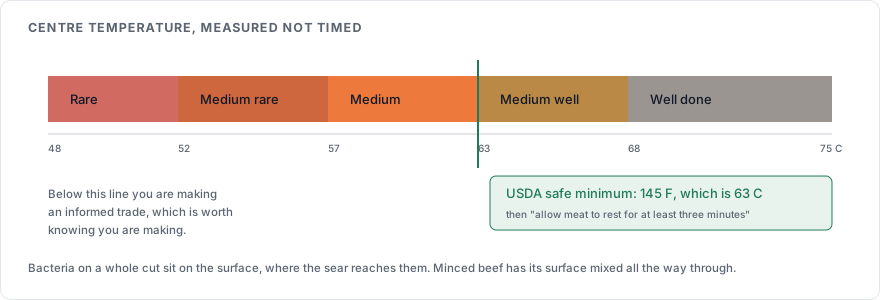
| Doneness | Temperature at the centre |
|---|---|
| Rare | 50 to 52 C |
| Medium rare | 54 to 57 C |
| Medium | 60 to 63 C |
| Medium well | 65 to 68 C |
| Well done | 71 C and above |
Those are the kitchen conventions for doneness. The food safety figure is separate and higher: the USDA Food Safety and Inspection Service directs you to "cook all raw beef, pork, lamb and veal steaks, chops, and roasts to a minimum internal temperature of 145°F as measured with a food thermometer before removing meat from the heat source", then to "allow meat to rest for at least three minutes before carving or consuming".
145 F is 63 C, which lands at medium. Anyone cooking a whole-muscle steak rarer than that is making an informed trade, and it is worth knowing that is the trade being made. The reasoning behind the distinction is that bacteria on a whole cut stay on the surface, which a sear reaches. Minced beef has its surface mixed all the way through, which makes a burger a different question entirely.
Resting
Three minutes is the safety minimum quoted above. Five to ten minutes suits a thick steak, on a warm plate, loosely covered.
The centre keeps rising by a few degrees after the pan, so pull the steak below your target. A thick steak carries more stored heat and overshoots further than a thin one.
The pan is not finished
The browned residue stuck to the pan is fond, and it is the base of a sauce that takes four more minutes, covered in How to make a pan sauce. Pour the resting juices into it at the end.
Sources
USDA FSIS, Safe Minimum Internal Temperature Chart, for the 145 F figure and the three minute rest
Louis-Camille Maillard's 1912 papers on the reaction between amino acids and reducing sugars, which is what browning is
How to make a pan sauce, for what to do with the pan afterwards