How to store leftovers safely
October 1, 2026
Cooked food goes into the fridge within two hours, in shallow containers so it cools fast, at 4 C or below. It keeps for three to four days. The clock, the container depth and the fridge temperature are the three things that decide whether that is true.
The danger zone
The USDA Food Safety and Inspection Service names the range where bacteria multiply quickly as 40 F to 140 F, which is 4 C to 60 C. Within it, they "can double in number in as little as 20 minutes".
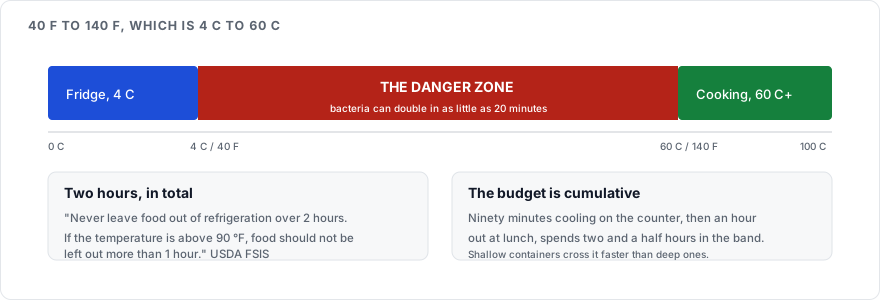
Everything below follows from that one band. Food is safe while it is colder than the bottom of it or hotter than the top, and the job is to move through the middle quickly and to spend as little total time there as possible.
The two hour rule
FSIS is direct about the limit: "Never leave food out of refrigeration over 2 hours. If the temperature is above 90 °F, food should not be left out more than 1 hour."
Ninety Fahrenheit is 32 C, so the one hour version applies to a hot kitchen, a car, or a table outdoors in summer.
The two hours is a cumulative budget across the food's whole life. Something left out for ninety minutes after cooking, refrigerated, then left out for another hour at lunch, has spent two and a half hours in the zone.
Cool it fast, which means shallow
A deep pot of stew put straight in the fridge can stay in the danger zone for hours at its centre while the outside is cold, and it warms everything around it while it tries.
Divide it into containers no more than about 5 cm deep. Surface area is what removes heat, so two flat boxes beat one deep one by a wide margin. An ice bath under the pan, with the food stirred, gets a large batch down quickly before it is divided.
Hot food can go straight into a modern fridge. The old advice to cool it on the counter first predates fridges that can cope, and following it burns your two hours.
The fridge itself
FSIS asks for 40 F, which is 4 C or below. Freezers run at minus 18 C.
Do not trust the dial. It shows the setting you chose, and a fridge that is overfull, badly sealed or standing in a warm room can sit several degrees above it. A cheap fridge thermometer left on a middle shelf answers the question in a day.
Arrange by drip, with raw meat and fish on the lowest shelf in sealed containers, so nothing can fall onto food that will be eaten without cooking. The door is the warmest part, which makes it the wrong place for milk and the right place for condiments.
How long things keep
| Food | Refrigerated at 4 C | Frozen at minus 18 C |
|---|---|---|
| Cooked leftovers | 3 to 4 days | 3 to 4 months |
Freezing holds food safe indefinitely at minus 18 C. The three to four month figure is about quality, since texture and flavour degrade long before anything becomes unsafe.
Label containers with the date. Judging by eye fails in both directions: it throws out food that is fine and keeps food that is not, because the bacteria that cause illness do not reliably announce themselves by smell.
Reheating
Reheat until the food is steaming hot all the way through, and stir partway if you are using a microwave, since microwaves heat unevenly and leave cold pockets where bacteria survive.
Reheat a portion once. Each cycle through the danger zone adds to the total, and a portion that has been out twice and chilled twice has spent far longer in the zone than its age suggests.
Sources
USDA FSIS, Danger Zone 40 F to 140 F, for the temperature band, the doubling time and the two hour rule
USDA FSIS, Leftovers and Food Safety, for the three to four day figure and shallow container cooling
USDA FSIS, Refrigeration and Food Safety, for the 40 F fridge target
How to sear a steak, for the cooking temperatures that get food safely out of the zone in the first place