How to read a time signature
September 28, 2026 · Updated September 30, 2026
The top number counts the beats in a bar. The bottom number names the note value that gets one beat, where 4 means a crotchet and 8 means a quaver. So 3/4 is three crotchet beats to the bar.
The bottom number
It is a fraction denominator, which is why it is always a power of two.
| Bottom number | Note value that gets the beat |
|---|---|
| 2 | Minim, or half note |
| 4 | Crotchet, or quarter note |
| 8 | Quaver, or eighth note |
| 16 | Semiquaver, or sixteenth note |
A bar of 3/4 and a bar of 3/8 hold the same count of beats. They differ in what is written on the page and, by convention, in how fast and how light the music feels.
Simple and compound
This is the distinction that makes 6/8 behave differently from 3/4, even though both bars hold six quavers.
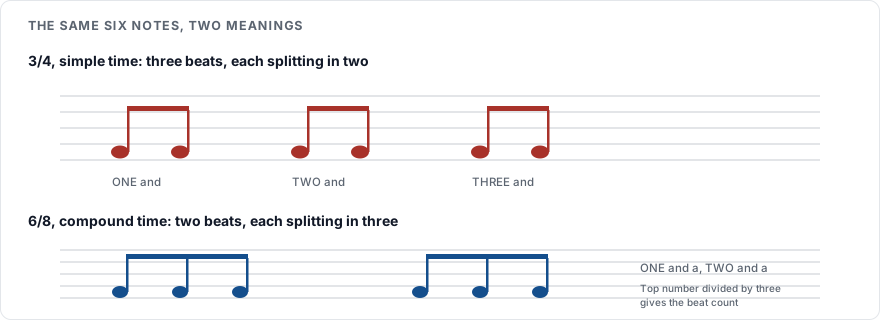
In a simple time signature, each beat divides into two. In a compound one, each beat divides into three, and the top number counts divisions instead of beats.
| Signature | Beats per bar | Each beat divides into | Counted as |
|---|---|---|---|
| 2/4 | 2 | 2 | ONE and TWO and |
| 3/4 | 3 | 2 | ONE and TWO and THREE and |
| 4/4 | 4 | 2 | ONE and TWO and THREE and FOUR and |
| 6/8 | 2 | 3 | ONE and a TWO and a |
| 9/8 | 3 | 3 | ONE and a TWO and a THREE and a |
| 12/8 | 4 | 3 | four groups of three |
To find the beat count in a compound signature, divide the top number by three. So 6/8 has two beats, each a dotted crotchet.
A bar of 3/4 and a bar of 6/8 both contain six quavers and group them differently: 3/4 is three groups of two, and 6/8 is two groups of three. Beaming on the page shows the grouping, which is why the same six notes are beamed differently in each.
The two symbols
A large C stands for 4/4 and is called common time. The same C with a vertical line through it stands for 2/2 and is called cut common or alla breve, where the minim takes the beat and the music is counted in two.
Neither symbol is an abbreviation of a word. The C is a broken circle inherited from mensural notation, where a full circle meant triple time.
Irregular and changing meters
A top number of 5 or 7 means the bar does not divide evenly, and the composer usually indicates the grouping, either by beaming or by writing the signature as a sum.
A bar of 7/8 written as 2+2+3/8 tells the player where the stresses fall. Without that, the grouping has to be taken from the beaming or from the accompaniment.
A change of signature mid-piece applies from the bar it appears in. Where the change is temporary, some editions print the old signature in brackets at the point it resumes.
How to count a bar you cannot read
Find the note values in one bar and add them up as fractions. A bar holding a dotted minim adds to three quarters, which fits 3/4. A bar holding a dotted crotchet twice adds to six eighths, which fits 6/8.
The arithmetic works because a time signature states how much a full bar holds. Anything that adds to more than the signature allows is a misprint or a bar with a tie across it.
What the signature does not tell you
It carries no tempo. A 4/4 bar can last half a second or four seconds, and only a tempo marking or a metronome figure settles that.
It carries no style either. Counting 12/8 gives you the grouping of a slow blues and none of its feel, which lives in where the player places the notes inside each group.
Sources
Open Music Theory, on meter, beat division and the notation of irregular groupings
How to build a major scale, for the other half of what a stave tells you before you play a note