How to make a sigil
September 30, 2026
Write your intention as one sentence, strike out every repeated letter, and combine the letters that survive into a single drawn glyph. That method comes from the artist Austin Osman Spare, who set it out in The Book of Pleasure in 1913, and it is the version practised today.
The five steps
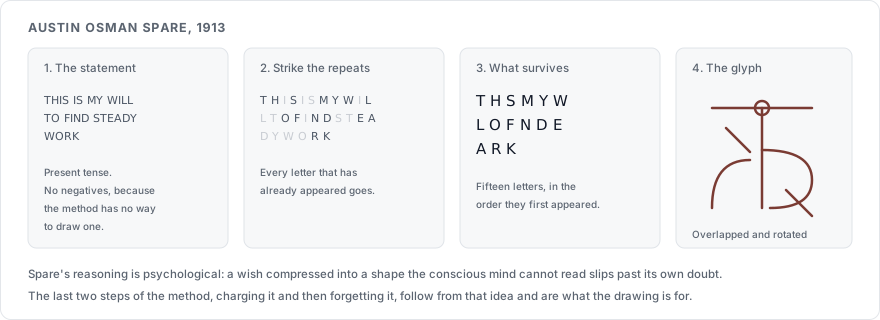
Write the statement. One sentence, present tense, no negatives. Spare's practitioners write "this my wish" constructions; modern chaos magic usually writes something like THIS IS MY WILL TO FIND STEADY WORK.
Remove the repeats. Take out every letter that has already appeared. THIS IS MY WILL TO FIND STEADY WORK reduces to T H I S M Y W L O F N D E A R K.
Draw the glyph. Combine those letters into one shape, overlapping and rotating them, dropping strokes where the shape improves. The result should stop looking like letters.
Charge it. Concentrate on the glyph in a state of high or emptied attention. Spare's own term for the state he used was gnosis, and practitioners reach it by exhaustion, by meditation, by shock or by other means.
Forget it. Put the sigil away, burn it, or bury it. The step matters to the method, because Spare's theory holds that the intention has to leave conscious memory to work.
Why the letters are removed
Spare argued from psychology, where the older traditions argued from symbolism. He held that a desire held consciously stays entangled with doubt about itself, and that a wish compressed into a shape the conscious mind cannot read slips past that.
The letter elimination and the deliberate forgetting are both there to serve that idea. They are what separate this method from an amulet inscribed with a legible word, which several older traditions use instead.
Where it came from and where it went
Spare published The Book of Pleasure (Self-Love): The Psychology of Ecstasy in 1913, privately and to almost no audience. He had passed through the Golden Dawn's orbit and Aleister Crowley's, and had rejected the elaborate ceremonial apparatus of both, which is the context for a technique needing a pen and a piece of paper.
The method reached a wider readership through chaos magic in the 1970s, particularly Peter Carroll's Liber Null in 1978, which stripped ritual down to results and took Spare's sigils as a central technique. From there it spread into general occult practice, and it now appears more often than any other single method.
The design world borrowed the word for something else entirely. A brand sigil or a game's faction sigil is a logo, and carries none of this method.
Variants in use
| Variant | How the glyph is made |
|---|---|
| Letter method | Spare's original: strike repeats, combine what remains |
| Pictorial | Draw an image of the outcome, then abstract it until it is unreadable |
| Mantric | Reduce the sentence to a spoken nonsense word instead of a shape |
| Magic square | Trace the letters' numeric values across a planetary kamea, a method older than Spare and taken from grimoire tradition |
The magic square version is the one with the longest history, and it runs the opposite way to Spare's: the glyph is generated by a fixed correspondence instead of by a free drawing.
What is being claimed, and by whom
Everything above describes a practice as its practitioners describe it. Spare's account of why it works is his own psychological theory, offered in 1913 and not tested since in any way that would satisfy a psychologist.
Writing a specific intention down in one sentence, and returning to a drawn reminder of it, are things a person can do whatever they believe about the rest.
Sources
Austin Osman Spare, The Book of Pleasure (Self-Love): The Psychology of Ecstasy, 1913, where the letter method and the forgetting are set out
Peter J. Carroll, Liber Null, 1978, which brought the technique into chaos magic
Austin Osman Spare, Wikipedia, for the biography and the publication history