How to tell the major arcana from the minor
September 30, 2026
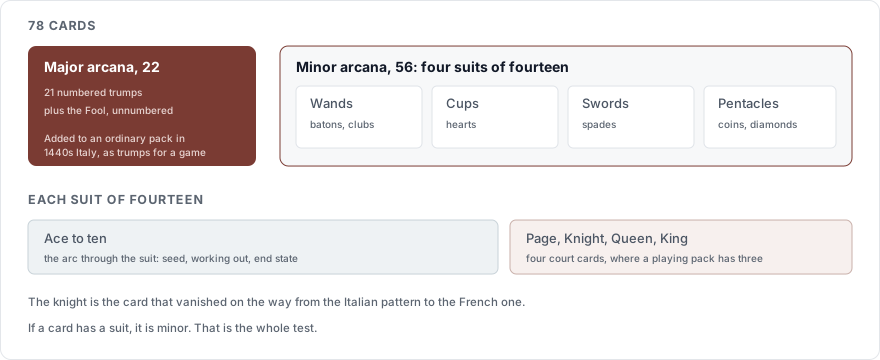
A tarot deck holds 78 cards in two groups. The major arcana are twenty-two: twenty-one numbered trumps and the unnumbered Fool. The minor arcana are the other fifty-six, four suits of fourteen. If a card has a suit, it is minor.
The structure
| Group | Count | What is in it |
|---|---|---|
| Major arcana | 22 | Twenty-one numbered trumps, from the Magician to the World, and the Fool, which carries no number or a zero |
| Minor arcana | 56 | Four suits of fourteen: ten numbered cards from ace to ten, then four court cards |
The four suits in the Italian pattern are batons, coins, cups and swords. English language decks usually rename batons as wands and coins as pentacles. The court of each suit is king, queen, knight and jack, the last often printed as page, which gives four court cards per suit where an ordinary playing card deck has three.
Where the division comes from
The two groups exist because one was bolted onto the other.
Ordinary four-suit packs were already in use in Europe when, between 1440 and 1450 in Milan, Ferrara, Florence and Bologna, decks appear with an extra run of allegorical picture cards added to them. The earliest documentation is a court record in Florence in 1440, covering the transfer of two decks to Sigismondo Pandolfo Malatesta.
Those extra cards were trumps in the card-game sense. They were added so the pack could play trick-taking games, of which Tarocchini is one, where a trump beats any card of any suit. The Italian name for them, trionfi, is the same word that gives English "trump".
So the majors are not an older or deeper layer. They are the newer part, and they are structurally a fifth suit that outranks the other four.
When the cards became divinatory
Three hundred years separate the game from the fortune telling.
The earliest known evidence of a tarot deck used for cartomancy is an anonymous manuscript from around 1750, listing rudimentary divinatory meanings for the cards of the Tarocco Bolognese.
The esoteric reading of tarot was popularised in Paris in the 1780s by Antoine Court de Gébelin and by Jean-Baptiste Alliette, who wrote under the name Etteilla, both working from the Tarot of Marseilles. Around 1789 Etteilla produced the first deck designed specifically for occult use.
Court de Gébelin also introduced the claim that the cards descend from ancient Egyptian wisdom. No evidence supports it, and the historian of cards Michael Dummett described the idea as the most successful propaganda campaign ever launched.
Knowing this changes how a reader treats the two groups. The Egyptian and kabbalistic correspondences attached to the majors were assigned in the eighteenth and nineteenth centuries, by named people, to a pack designed for a card game in the fifteenth.
Telling them apart in a spread
Practitioners who use the distinction read it as a difference of scale: majors for the larger movements of a situation, minors for its daily texture, courts for people or for stances a person takes.
A reading heavy with majors is treated as being about something structural, and one with none as being about ordinary matters. Under that convention, counting the ratio before reading any individual card gives the spread its frame, which matters most in a small layout like the one in How to read a three card spread.
Which decks you will meet
Three decks account for most of what is in print. The Tarot of Marseilles is the older French pattern, with unillustrated numbered suit cards. The Rider deck of 1909, drawn by Pamela Colman Smith, gave every card a scene, and most modern decks follow its imagery. The Thoth deck, designed by Aleister Crowley with Lady Frieda Harris, is the third.
A deck's own booklet matters more than any general guide, because the meanings a deck's designer intended are the ones its pictures were drawn to carry. What each suit carries is covered in How to read the four suits of the minor arcana.
Sources
Tarot, Wikipedia, for the dates, the deck structure, the court records and the history of divinatory use
Michael Dummett, The Game of Tarot (1980), the standard scholarly history of the cards as a game
How to read a three card spread, for what to do once the deck is shuffled