How to season a cast iron pan
October 1, 2026
Seasoning is a hard layer of polymerised oil bonded to the iron. Build it from coats so thin the pan looks dry, each one heated past the oil's smoke point, and repeat. Thickness is what ruins it.
What the layer is
Heating a thin film of oil past its smoke point breaks the fat molecules apart and cross-links them into a solid, continuous film. That film is closer to a hard varnish than to grease, and it is bonded to the metal rather than sitting on it.
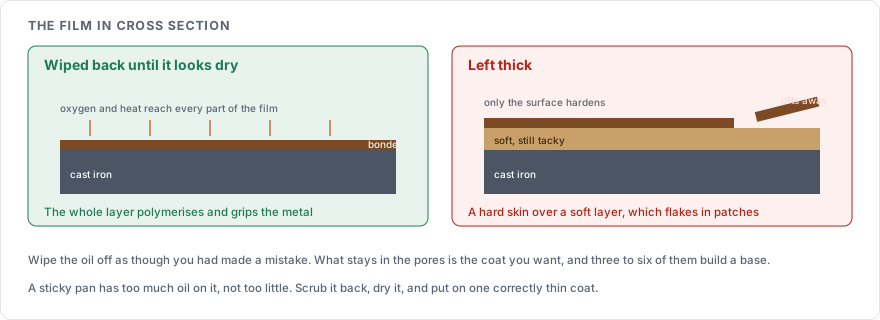
Harold McGee's On Food and Cooking describes the chemistry: the reaction needs oxygen, heat and a film thin enough for both to reach every part of it. A thick coat cannot polymerise all the way through, so the surface hardens over a soft layer that stays tacky and eventually flakes away in patches.
That is the single mistake to avoid. Everything else in the method exists to keep the film thin.
The method
Clean the pan back to bare metal if it is new, rusted or flaking. Hot water, a stiff brush and detergent, or steel wool where there is rust.
Dry it completely on a low hob burner until no moisture is left. Bare cast iron flash-rusts in minutes.
Put in a teaspoon of oil and rub it over every surface, inside, outside and the handle.
Wipe it all off again with a clean cloth, as though you had made a mistake. What stays behind in the pores is the coat you want.
Bake upside down at 230 C for an hour, with a tray underneath. Upside down stops any pooling.
Let it cool in the oven, then repeat from step 3. Three to six coats build a usable base.
The pan darkens with each pass, from grey to bronze to near black. A patchy colour after the first coat is normal.
Which oil
The useful properties are a smoke point below your oven temperature and a tendency to polymerise.
| Oil | Smoke point | Notes |
|---|---|---|
| Grapeseed | around 215 C | A common default, polymerises well |
| Sunflower, refined | around 230 C | Widely available, reliable |
| Rapeseed or canola | around 205 C | Cheap and works |
| Flaxseed | around 107 C | Polymerises hardest of all, and the layer is brittle enough that many people find it chips |
| Olive oil, extra virgin | around 190 C | Low smoke point and a tendency to stay sticky |
Flaxseed produces a glassy finish and divides opinion, because the same hardness that makes it look impressive makes it shed in flakes when the pan flexes with heat. A refined neutral oil gives a duller, more forgiving layer.
Maintaining it
Cooking in the pan maintains the seasoning, particularly anything fried. A pan used weekly needs no ceremony.
After each use, wash while warm, dry on the hob until bone dry, and wipe a trace of oil over the cooking surface. The drying step matters more than the oiling.
Soap is fine. The rule against it dates from when household soap was lye-based and strong enough to attack the polymer. Modern washing-up liquid removes food and grease and leaves the bonded layer alone. What does strip seasoning is a long soak, a dishwasher, or scouring back to metal.
What damages it, and how to recover
Acid is the main enemy. A long simmer of tomato or wine sauce eats into the layer, so keep those for a pan with an established coat and expect to touch it up afterwards.
Rust means the layer was broken and water reached the iron. Scour the rust off, then start again from step 1. A cast iron pan cannot be ruined by anything short of cracking it, which is the reason they outlive their owners.
A sticky pan has too much oil on it. Scrub it back with hot water and a brush, dry it, and put on one correctly thin coat.
Sources
Harold McGee, On Food and Cooking (2004), on fat polymerisation and what heat does to oils
The smoke points above are typical published values for refined oils, and they vary with refinement and freshness, so treat them as a guide to oven temperature rather than as constants
How to sear a steak, for what a well-seasoned pan is for