How to read a resistor colour code
September 27, 2026 · Updated September 30, 2026
Start from the end with the widest gap before the last band, or from the gold or silver band if the part has one. On a four band resistor the first two bands are digits, the third multiplies, the fourth is tolerance. A five band part has three digits instead of two.
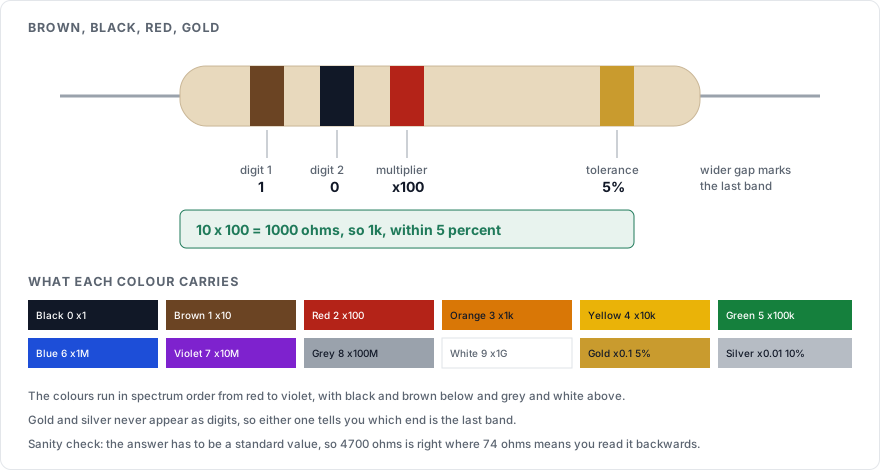
The table
| Colour | Digit | Multiplier | Tolerance | Temperature coefficient |
|---|---|---|---|---|
| Black | 0 | x1 | ||
| Brown | 1 | x10 | 1% | 100 ppm/K |
| Red | 2 | x100 | 2% | 50 ppm/K |
| Orange | 3 | x1000 | 15 ppm/K | |
| Yellow | 4 | x10 000 | 25 ppm/K | |
| Green | 5 | x100 000 | 0.5% | |
| Blue | 6 | x1 000 000 | 0.25% | 10 ppm/K |
| Violet | 7 | x10 000 000 | 0.1% | 5 ppm/K |
| Grey | 8 | x100 000 000 | 0.05% | |
| White | 9 | x1 000 000 000 | ||
| Gold | x0.1 | 5% | ||
| Silver | x0.01 | 10% |
The colours run in the order of the visible spectrum from red to violet, with black and brown below them and grey and white above. That ordering is the whole memory aid, and it is worth more than any mnemonic built on first letters.
Working through one
Take a part banded brown, black, red, gold. Brown is 1 and black is 0, so the digits read 10. Red multiplies by 100, which gives 1000 ohms, or 1k. Gold puts the value within 5 percent of that, so somewhere between 950 and 1050 ohms.
Five bands work the same way with an extra digit. Brown, black, black, brown, brown reads 1, 0, 0 with a x10 multiplier, giving 1000 ohms again, held to 1 percent. The five band version of a value exists because the part is precise enough to need three significant figures, and writing a 1 percent part in four bands would throw one away.
Which end is the start
Three things tell you, in this order of reliability.
The tolerance band is gold or silver on most parts, and neither colour appears in a digit position. If you can see gold or silver, it is the last band, unless it sits in the third position on a low value part, where it is a multiplier for values under 10 ohms.
The gap is wider between the multiplier and the tolerance band than between the digit bands. On a small part that is a fraction of a millimetre, so treat the gap as confirmation once you have decided some other way.
The answer has to be a standard value. Resistors are made in the E-series of IEC 60063, so E12 parts read 10, 12, 15, 18, 22, 27, 33, 39, 47, 56, 68 or 82 followed by zeros. Read a part as 4700 ohms one way and 74 ohms the other, and 4.7k is the series value while 74 is not, so you were holding it backwards.
Six bands, and the odd ones
A sixth band is the temperature coefficient in parts per million per kelvin. It matters when a circuit has to hold its calibration across a temperature range, and the first five bands are read as usual.
A single black band means a zero ohm link, which is a wire in a resistor's body, put there so that a machine can fit a jumper the same way it fits everything else.
A chunky package with a wide silver or gold body band is usually a fusible or wirewound type, where the marking scheme is printed text instead of colours.
When the colours have gone
Heat and cheap paint make brown and red hard to separate under warm light, and violet and blue hard to separate under any light.
The reliable answer is an ohmmeter. Across a part out of circuit it answers in a second. In circuit it reads whatever is in parallel with the part, which is why the part has to come out first.
Failing that, read the bands in daylight or under a neutral white lamp. Colour judgement under an orange filament bulb is where most misreadings come from, and nothing in the code compensates for the light you read it under.
Surface mount parts skip the problem by using numbers. Three digits mean two figures and a count of zeros, so 472 is 4700 ohms. Four digits mean three figures and a count, so 4701 is also 4700. An R marks the decimal point, so 4R7 is 4.7 ohms.
Sources
IEC 60062, the standard defining marking codes for resistors and capacitors, including the colour code and the three and four digit schemes
IEC 60063, the preferred value series that makes the sanity check work
How to choose a resistor for an LED, for picking the value in the first place